

Giving respect to the people of the Wongaibon Nation, Callubri Station acknowledges the land’s traditional owners alongside its pioneering past. Understanding the Indigenous history of the land is a vital part of the Callubri Station story. We acknowledge that we are custodians of a landscape that has been nurtured for tens of thousands of years.
Purchased in 1878 by the Armstrong family, Callubri Station is steeped in four generations of family farming heritage. The 28,500-acre Merino sheep station is the backbone of the agritourism enterprise. Offering guests a rare glimpse into Australian family farming, the property showcases ‘the everyday of outback life’ with a bit of flair. However, like any authentic rural experience, authenticity remains firmly at it’s heart.

The sheep station is nestled between the remote country towns of Nyngan and Tottenham in Central West NSW. Located close to the centre of NSW, the property is easily accessible by road or private plane.
With a strong focus on sustainability, farm stay guests enjoy a true paddock-to-plate experience. Accommodating up to 14 guests overnight and larger groups for dining, the property’s true luxury lies in it’s exclusivity. Hosted personally by the station owners, and their dedicated team, Callubri Station delivers an unparalleled outback Australian experience.
Your Hosts
Angie and Michael Armstrong share a passion for farming and life in outback Australia.
Raised on a small family farm in the rolling hills of the Yarra Valley, Angie spent her childhood surrounded by Melbourne’s culture and cuisine. As a fourth-generation custodian of Callubri Station, Michael’s dedication to the land and love of farming is clear.
United in their love for the land, they endeavour to foster a stronger connection between urban and rural communities. Embracing an ongoing commitment to sustainability practices, they actively work towards positive change for the environment and future generations. This ethos, they believe, embodies the essence of contemporary agritourism. Learn more about the owners of the Merino sheep station and their team here…
Our Wool


With a rich heritage in Merino Wool production, Callubri Station manages a self-replacing Merino flock of 12,000 sheep. Proudly RWS certified , we uphold rigorous standards to elevate sheep health and land management practices. Our commitment to the RWS accreditation reflects our dedication to the holistic integrity of our business.
RWS certification offers transparent supply chain tracking, verified by both internal and third-party assessments. This ensures that brands and consumers alike can trust that our wool originates from a farm devoted to high standards of sheep welfare and sustainable land management. For further details on the RWS program please click here.
Our Farming

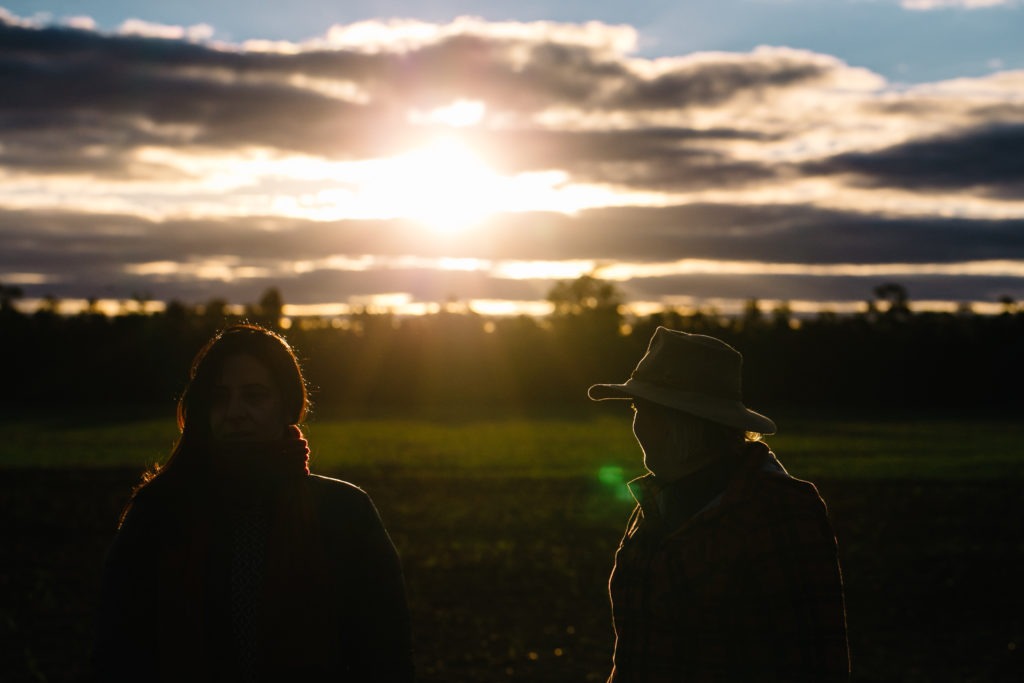
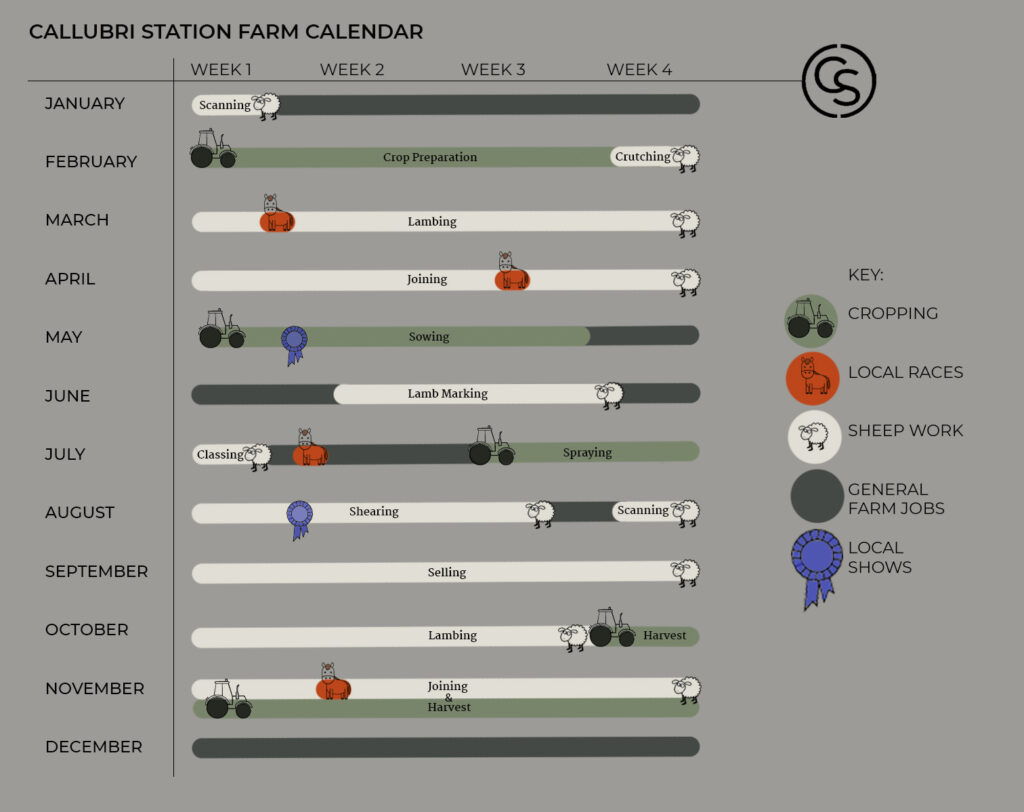
Callubri Station falls within a marginal cropping region. With an average annual rainfall of 450mm, the property regularly faces unpredictable weather alongside fluctuating global markets. The station sows on average 4000 acres to a mix of Wheat, Canola, Oats, Barley and Lupins each year. To preserve precious moisture and maintain ground cover between crops, the team employs minimum to zero till techniques when preparing the land.
How large is 28,500 acres, and what kind of terrain will we see?
To put it into perspective, Callubri Station is roughly the size of 16,000 football fields or larger than many international airports. Because of this vast scale, the terrain is incredibly diverse. You’ll traverse open alluvial plains perfect for our Merino sheep, stand atop “The Lookout” with 360-degree views of the Western Plains, and explore ancient Myall and Rosewood scrub. The land is a mosaic of red soil, saltbush, and ephemeral watercourses that change dramatically with the seasons, offering a raw and untouched beauty that feels truly “off the beaten track.”
What does ‘Regenerative Farming’ actually look like on the station?
At Callubri, regenerative farming is our visionary commitment to leaving the land in better condition for the next generation. Unlike traditional set-stocking, we use “rotational grazing,” which allows our paddocks long periods of rest to recover and for native grasses to go to seed. You’ll see the results in the vibrant biodiversity of our flora and the health of our soil. Mike is passionate about sharing how we manage our water cycles and ground cover to create a resilient ecosystem that thrives even in the harsh Australian climate. It’s a grounded, sustainable approach to agriculture that you can see and feel as you move across the property.
Whose Traditional Lands is Callubri Station located on?
Callubri Station sits on the traditional lands of the Wongaibon people, part of the larger Ngiyampaa language group. This region of Central West New South Wales has a rich cultural history, with the Wongaibon people having a deep, spiritual, and physical connection to the vast alluvial plains. We pay our respects to their Elders past, present, and emerging, and we are committed to sharing the story of this land with the gravity and respect it deserves.
How do you integrate Indigenous culture into the guest experience?
We believe in an authentic, “grounded” approach to cultural immersion. For our groups and corporate retreats, we can facilitate private experiences with local Wongaibon and Ngiyampaa Knowledge Holders. This may include traditional smoking ceremonies to welcome guests to country, language and dance storytelling sessions that provide a perspective on how the land was managed long before the first Merino sheep arrived.